How to Localize Training Content to 40+ Languages Without Re-Filming
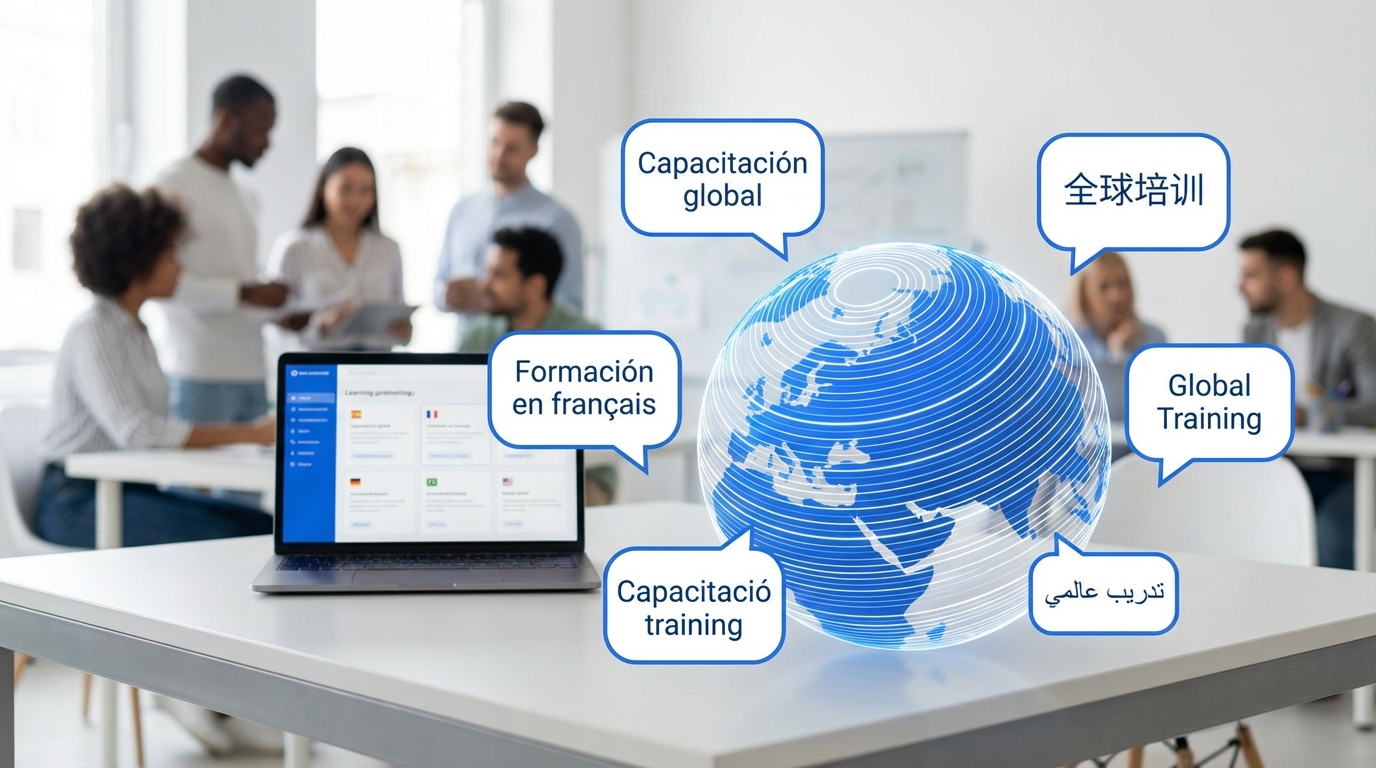
If your company operates across borders, you already know the problem: training content that works in English does not automatically work in German, Japanese, or Arabic. Translation is only part of the challenge. You need natural-sounding delivery, cultural sensitivity, and the ability to update everything when the source content changes.
The traditional approach is broken
Most companies handle localization in one of two ways. They either subtitle the original video, which learners tend to ignore, or they re-produce the entire video with local presenters. Subtitling is cheap but ineffective. Re-production is effective but impossibly expensive at scale.
A third option has emerged: AI-powered localization that keeps the original avatar, generates natural speech in the target language, and syncs lip movement to match. The result looks and sounds like a native-language video, because functionally it is one.
How AI localization actually works
The process is straightforward. You create your training content once in any language. The AI translates the script, generates speech in the target language using neural voice synthesis, and re-renders the video with synchronized lip movement. The avatar, slides, and visual structure remain consistent.
This is not machine translation dumped over a static video. The entire presentation adapts. Timing adjusts for languages that run longer or shorter than the original. Pronunciation is natural, not robotic. The output is a complete, standalone training module in each language.
What to look for in a localization platform
Not all AI localization is equal. The key differentiators are voice quality, lip sync accuracy, language coverage, and update workflow. You want a platform where updating the source content automatically flags all localized versions for re-rendering. Otherwise you end up with version drift, which is worse than having no localization at all.
SCORM export matters too. If your LMS tracks completion by language, your localization tool needs to produce separately packaged modules, not just translated MP4 files.
The ROI is immediate
Companies that switch from manual re-production to AI localization typically see 90% cost reduction per language. A module that cost $8,000 to localize into one language now costs a fraction of that for all 40+. More importantly, the turnaround drops from weeks to hours.
For compliance training, this is not a nice-to-have. It is a regulatory requirement. Every employee needs to receive training in a language they understand. AI localization makes that feasible for the first time.

TO SEE Team
Author
Frequently Asked Questions
Everything you need to know about TO SEE
- Simply describe your training topic, audience, and goals in plain language. The AI agent creates a structured training video with professional avatars, visual aids, and clear narration. You can iterate on the content through conversation, just like working with a real production team.
- We support over 40 languages including Arabic, Chinese, Danish, Dutch, English, French, German, Hindi, Italian, Japanese, Korean, Norwegian, Polish, Portuguese, Russian, Spanish, Swedish, and many more. Your training content maintains natural-sounding delivery across all languages.
- Yes. TO SEE supports SCORM 1.2 and 2004 export, so your training content can be deployed directly into any standards-compliant Learning Management System. You can also export as MP4 for quick sharing via email, Slack, or any other channel.
- Most training videos can be created in minutes, not days. Describe your topic to the AI agent, review the generated content, make any adjustments through conversation, and export. The entire workflow typically takes 10-15 minutes for a complete training module.
- Our professional avatars are created from real filmed footage, delivering human-quality presentation with natural lip sync, expressions, and movement. They look and feel authentic, building trust with learners and maintaining engagement throughout training content.
- Absolutely. We are fully GDPR compliant and run on European data centers. We support enterprise-grade security including SSO, role-based access control, and flexible hosting options. We support enterprise-grade security reviews for teams that need additional assurance.
- Yes. Record a short 1-minute video and provide 3 minutes of audio samples. Our AI creates a digital twin that can deliver any script in your voice and likeness across all supported languages. Consent verification ensures digital twins can only be created with explicit approval.
- Yes. We offer enterprise plans with custom API integration, SSO support, dedicated account management, priority support, and flexible deployment options including on-premises. Contact us to discuss your organization's specific needs.
Create your first training video today
No cameras. No production bottlenecks. Just talk to AI.