SCORM vs MP4: Which Format Should You Use for Training Videos?
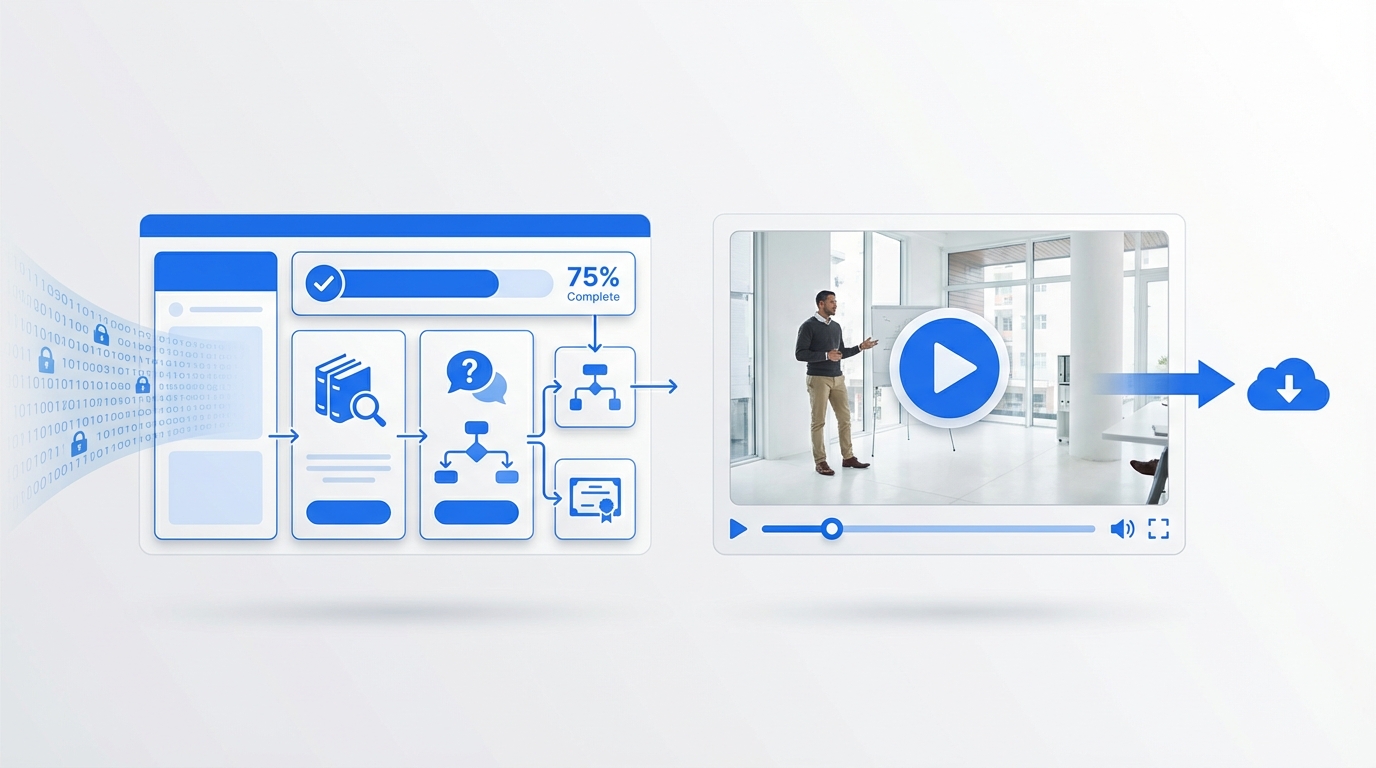
When your training video is ready, you have a choice: export it as an MP4 file or package it as a SCORM module. The decision affects how learners access the content, how you track completion, and how the content integrates with your existing systems.
When MP4 is the right choice
MP4 is simple. It is a video file that plays anywhere: email, Slack, SharePoint, an intranet page, a mobile device. There is no LMS required. For quick updates, informal training, or content that needs to reach people fast, MP4 is hard to beat.
The trade-off is tracking. You cannot know who watched the video, how much they watched, or whether they passed a comprehension check. For voluntary learning, team updates, or supplementary content, that is fine. For mandatory compliance training, it is not.
When SCORM is essential
SCORM (Sharable Content Object Reference Model) wraps your training content in a package that communicates with your Learning Management System. It tracks who started the content, who completed it, quiz scores, and time spent. This data is not optional for regulated industries.
SCORM 1.2 is the most widely supported version. SCORM 2004 adds sequencing and more granular reporting. If your LMS supports 2004, use it. If you are not sure, 1.2 works with virtually every LMS on the market.
Why you should not have to choose
The best training platforms export both formats from the same source content. You create the module once and get an MP4 for quick sharing and a SCORM package for LMS delivery. When the content updates, both outputs regenerate.
This matters because training content often serves multiple audiences. The compliance team needs SCORM tracking. The manager who wants to share a refresher with their team needs an MP4 they can drop into a Slack channel. Same content, different distribution.
What about xAPI?
xAPI (Experience API, also called Tin Can) is the next generation of SCORM. It tracks learning activities outside the LMS: mobile apps, simulations, on-the-job tasks. Adoption is growing but LMS support is still inconsistent. For most organizations in 2026, SCORM remains the practical choice. If your LMS supports xAPI and you have the infrastructure to use it, it is worth exploring.

TO SEE Team
Author
Frequently Asked Questions
Everything you need to know about TO SEE
- Simply describe your training topic, audience, and goals in plain language. The AI agent creates a structured training video with professional avatars, visual aids, and clear narration. You can iterate on the content through conversation, just like working with a real production team.
- We support over 40 languages including Arabic, Chinese, Danish, Dutch, English, French, German, Hindi, Italian, Japanese, Korean, Norwegian, Polish, Portuguese, Russian, Spanish, Swedish, and many more. Your training content maintains natural-sounding delivery across all languages.
- Yes. TO SEE supports SCORM 1.2 and 2004 export, so your training content can be deployed directly into any standards-compliant Learning Management System. You can also export as MP4 for quick sharing via email, Slack, or any other channel.
- Most training videos can be created in minutes, not days. Describe your topic to the AI agent, review the generated content, make any adjustments through conversation, and export. The entire workflow typically takes 10-15 minutes for a complete training module.
- Our professional avatars are created from real filmed footage, delivering human-quality presentation with natural lip sync, expressions, and movement. They look and feel authentic, building trust with learners and maintaining engagement throughout training content.
- Absolutely. We are fully GDPR compliant and run on European data centers. We support enterprise-grade security including SSO, role-based access control, and flexible hosting options. We support enterprise-grade security reviews for teams that need additional assurance.
- Yes. Record a short 1-minute video and provide 3 minutes of audio samples. Our AI creates a digital twin that can deliver any script in your voice and likeness across all supported languages. Consent verification ensures digital twins can only be created with explicit approval.
- Yes. We offer enterprise plans with custom API integration, SSO support, dedicated account management, priority support, and flexible deployment options including on-premises. Contact us to discuss your organization's specific needs.
Create your first training video today
No cameras. No production bottlenecks. Just talk to AI.